主题
Free Content
If you asked ChatGPT, Gemini, Copilot, or any of Google’s AI features to recommend a data catalog, one brand would come back more than any other. In our just-turned-on 5,000-prompt B2B Visibility Index study (more on that coming soon), Atlan kept popping up as the most-cited vendor in its category. The data democratization company is present in 58.9% of the data-catalog answers across all five primary LLMs.

"Ask AI for a data catalog. It keeps saying Atlan." Hero stat: 58.9% of data-catalog answers name Atlan across all five engines. Flow visual: own-site citations (237) feeding the AI answer, third-party mentions (328) feeding the same answer. Footer stats: 35% vendor citation share, 1.6x the runner-up; cited on ChatGPT, Google AI Overviews, Google AI Mode, Gemini, and Microsoft Copilot. Build as a 1:1 square with Foundation branding so it reads on its own in a feed.
Here is what this teardown covers and what it means for you even if you’ve never heard of a data catalog before:
- Atlan’s citations come from a small library of content: 52 of its pages earned citations in the study, with 13 of them carrying the most volume. One of those pages earned 16 variations of the same buyer question by itself.
- Every one of those workhorse pages was designed to hit all four E-E-A-T signals on purpose: doing so meant the LLM had something to cite.
- Those 52 pages account for 3,886 US keywords: 71% of them trigger an AI Overview, which means they have pages that win the classic search result and feed the AI answer above it.
All of the above were possible because of E-E-A-T. Let’s break down how the pages are built, why models and Google both trust them, and what you and your team members can swipe at scale.
You don’t need brute-force publishing or a large library to win in the LLMs.
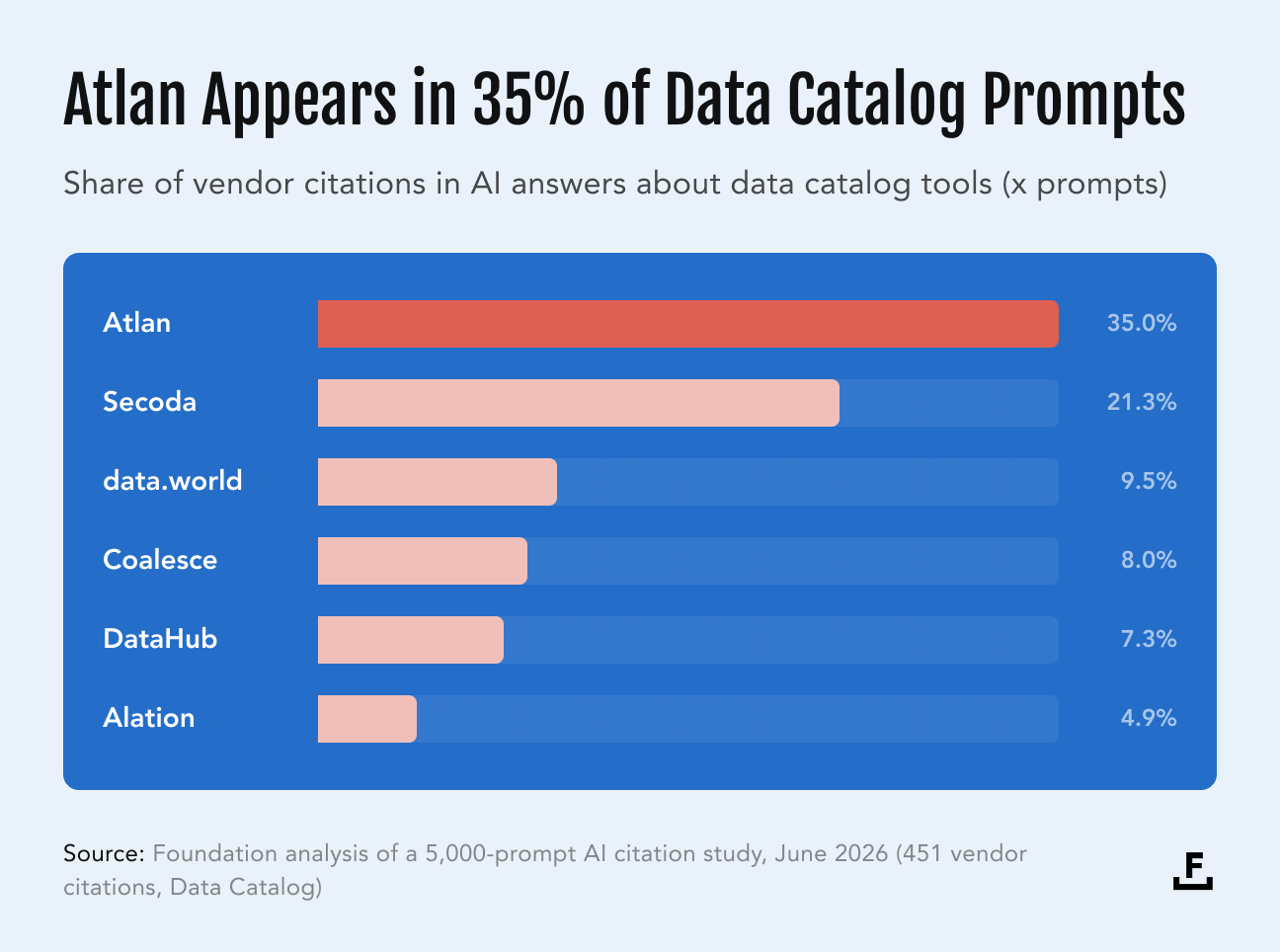
Atlan earned 237 own-site citations in the study, the pages models pulled from directly. It also collected 328 third-party mentions, that is the number of times another site named Atlan inside an answer. Together those give it a 35% share of vendor citations in the category, which is 1.6 times more than the runner-up.
To do this, they needed:
- 52 pages earning citations
- 13 of those pages earning the most citations
- 1 page earning 16 different query variations
Stop arguing about acronyms, go back to E-E-A-T
As Ross Simmonds mentioned at SEO Week, the industry is burning energy fighting over GEO, AEO, and HEO while missing what moves the needle. We need to accept that the ten blue links are gone and that Google has become a destination. And then double down on fundamentals such as E-E-A-T paired with an AI visibility philosophy.
Ignoring E-E-A-T now is like ignoring a Tamagotchi in 1997. Google still runs discovery for most of the internet, so the same signals that earn rankings earn AI citations.
— Ross Simmonds, SEO Week
In the AI web, LLMs scan the web for evidence to support their answers. And content built on real experience, proprietary data, and named expertise enables the machines to trust, understand, and rank your content. Commodity content, the kind a model can now generate in a sentence, gives them nothing to cite and loses value in any mature market. Atlan built a library chock full with non-commodity content.
The workhorse pages, and the buyer questions they own
Atlan’s citations come from a specific set of pages, each built to own a primary keyword and each cited repeatedly across engines. These are the workhorses:
| Page | Primary keyword | Query variations won | Citations | Engines |
|---|---|---|---|---|
| /data-catalog-tools | data catalog tools | 16 | 40 | 5 |
| /know/data-observability-tools | data observability tools | 15 | 26 | 4 |
| /alation-vs-collibra-vs-informatica-vs-atlan | alation vs collibra vs informatica | 7 | 14 | 4 |
| /collibra-vs-atlan | collibra vs atlan | 5 | 13 | 5 |
| /know/how-to-choose-collibra-vs-alation | collibra vs alation | 5 | 12 | 2 |
| /dagster-vs-luigi | dagster vs luigi | 5 | 11 | 5 |
| /know/top-vector-databases-enterprise-ai | best vector databases | 9 | 10 | 4 |
| /amundsen-vs-datahub | amundsen vs datahub | 6 | 9 | 4 |
| /open-source-data-catalog-tools | open source data catalog tools | 3 | 9 | 5 |
Two things stand out here:
- The top page wins a buyer intent, not a phrasing: /data-catalog-tools does not win one query. It wins 16 variations of the same buyer question, which is what happens when a page answers the whole intent instead of a single keyword.
- The content mix is built for decisions: Comparison and buyer-guide formats such as “best X” and “X vs Y,” “how to choose” are their primary content type. Those are the questions people ask an AI model when they are close to buying.
The E-E-A-T Anatomy of Atlan’s Citable Pages
If you’re looking to set up a page with similar results, the two top-cited guides, /data-catalog-tools and /know/data-observability-tools, work as templates you can use.
Atlan’s approach is:
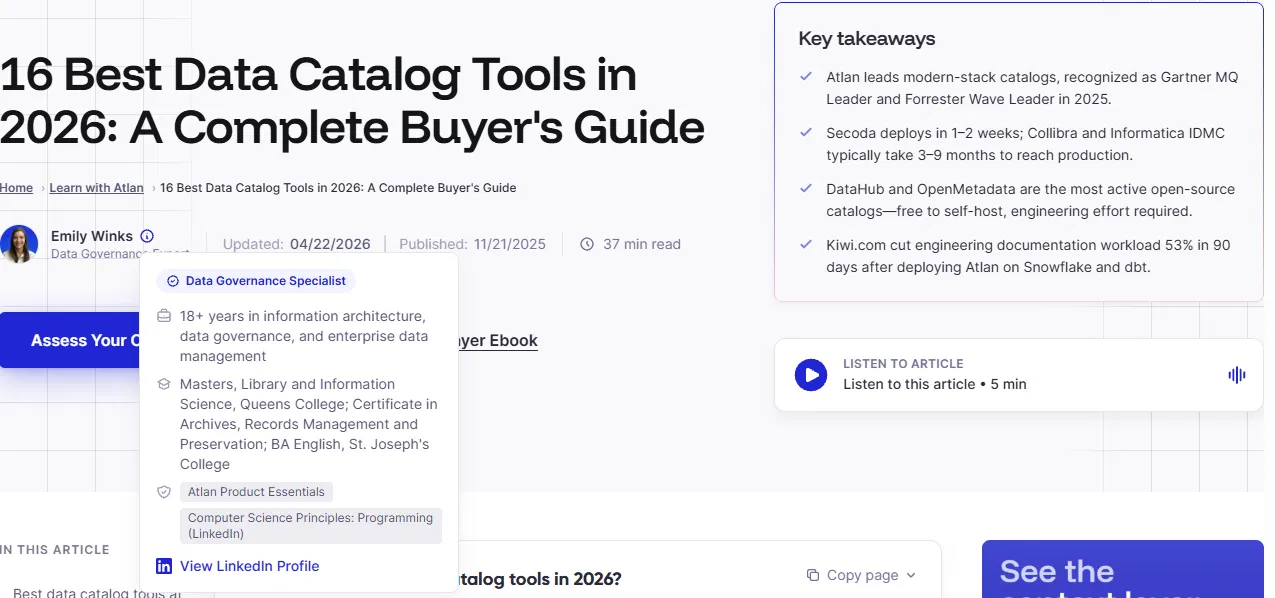
- A visible byline linked to an expert author (Emily Winks on the data-catalog guide, Heather Devane on the observability guide).
- A published date and a recent updated date. The data-catalog guide reads Published 11/21/2025, Updated 04/22/2026, which signals freshness.
- A read-time estimate: 37 minutes on the catalog guide, 26 on the observability guide.
- A “Key takeaways” box at the top that states the answer in a few plain sentences, the extractable summary models lift directly into responses.
- Cited research and analyst recognition, with Gartner Magic Quadrant and Forrester Wave references sitting inside the takeaways.
- An audio version.
Each element gives a reader a reason to trust the page before scrolling, and gives a model a reason to quote it.
The E-E-A-T signals on Atlan’s High-Visibility Pages
Every cited workhorse hits all four E-E-A-T signals on purpose. Here is the mapping to the graphic, one signal at a time.
Experience: firsthand proof, not claims
The Experience column lists case studies, proprietary data, “I analyzed,” and author pages. Atlan’s guides carry all of them.
Start with the customer proof. The pages show real customers and real outcomes instead of asserting that the product works:
- Kiwi.com consolidated thousands of assets into 58 data products, cut central engineering workload by 53%, and lifted data-user satisfaction 20% inside 90 days.
- Austin Capital Bank’s Head of Data and Analytics is quoted by name.
- General Motors and NASDAQ deployments are described with specifics, not adjectives.
Alongside the case studies sits firsthand analysis a spec sheet cannot give: sourced G2 ratings pulled in a named month, deployment timelines by vendor, connector counts, quick-fact tables. That is the “case studies,” “proprietary data,” and “I analyzed” items made concrete.
The author page is the other Experience signal on the slide, and it is where the byline resolves to a practitioner with a real track record rather than a brand:
[Side-by-side card. Title: “One author page, two E-E-A-T signals.” Pair the Emily Winks and Heather Devane author pages. Annotate the career narrative as Experience and the credentials (Master’s in Library and Information Science, Northwestern journalism degree, linked LinkedIn and author archives) as Expertise, with a connector showing the same page earns both. Build to stand alone on socials.]
- Emily Winks came to data through library and information science, moving from children’s librarian to information architect at WeWork to Atlan’s Founder’s Office across 18-plus years. That career arc is firsthand experience a reader, and a model, can see.
- Heather Devane built a content and brand practice from the ground up at Immuta before leading editorial strategy on enterprise AI at Atlan, 13-plus years of hands-on work in the field.
The bio narrative is the Experience layer. The credentials on that same page are the Expertise layer, which is the next signal.
Expertise: the credentials on those same author pages
The credentials on those same pages, item by item:
- Credentials. Emily Winks holds a Master’s in Library and Information Science and a Certificate in Archives, Records Management and Preservation from Queens College (CUNY), plus a B.A. from St. Joseph’s University. Heather Devane holds a B.S. in Journalism from Northwestern.
- Verifiable bios. Each author page links out to a LinkedIn profile and a dedicated Atlan author archive (atlan.com/authors/emily-winks, atlan.com/authors/heather-devane), so the claims are checkable rather than asserted.
- Real research and subject mastery. Devane has published 8-plus industry research reports, and each page states its author’s coverage areas: Winks on data governance and information architecture, Devane on the context layer and enterprise AI.
A generic “Team” byline signals none of this, to a reader or to a model parsing the page for authorship.
Authority: recognition the rest of the web repeats
Authority is the one signal you cannot fake on your own domain.
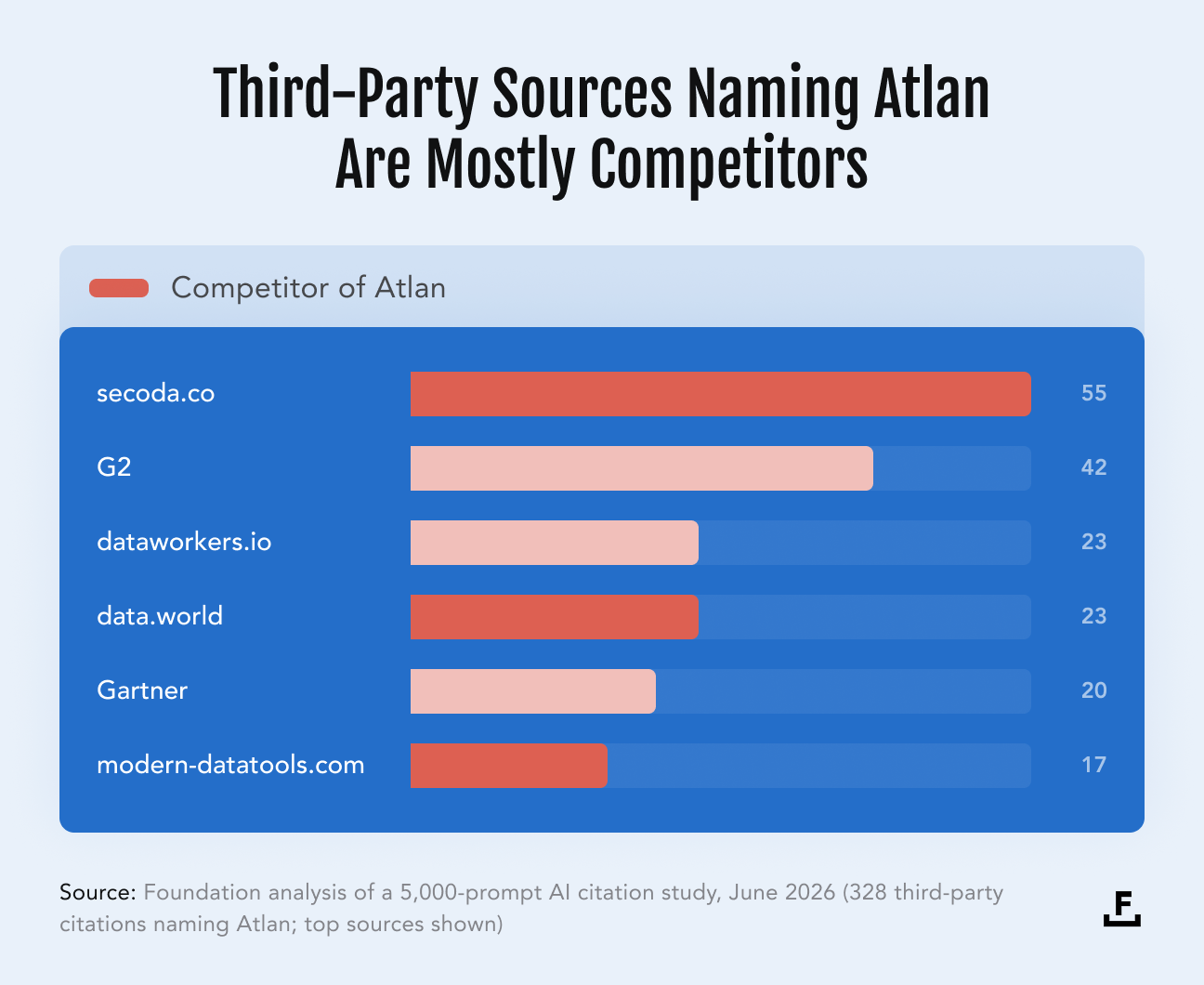
The study found 328 third-party citations naming Atlan across 104 answers. The top sources are a mix of review platforms, analysts, and independent roundups: secoda.co (55), G2 (42), dataworkers.io (23), data.world (23), Gartner (20), and modern-datatools.com (17). Two of those, secoda.co and data.world, are direct competitors, and when a rival’s page names you, that peer citation works in your favor. Reddit adds another 15, the UGC-presence signal from the slide.
The backlink profile puts numbers behind it. Atlan holds a Domain Rating of 75 and roughly 6,200 referring domains. The high-authority slice, domains rated DR 70 and above, runs to 483 clean domains, 81 of them at DR 90 or higher.
| Referring domain | Domain Rating |
|---|---|
| github.com | 97 |
| wikipedia.org | 97 |
| microsoft.com | 96 |
| nih.gov | 95 |
| forbes.com | 94 |
| medium.com | 94 |
| springer.com | 93 |
| hubspot.com | 93 |
| prnewswire.com | 92 |
| businesswire.com | 92 |
| atlassian.com | 92 |
| deloitte.com | 92 |
Press wires, enterprise software brands, media, and academic publishers all point at atlan.com. That is the reputation a model inherits when it decides whose page to summarize.
Links still matter here too. There is a growing claim that only citations and branded mentions count now, and that links are finished. Ross calls that nonsense, and the mechanics back him up: Google owns Gemini and has spent years training its models to avoid citing the spammy content that surfaces on some other engines. Links remain a core authority signal in that effort, so they line up with E-E-A-T rather than competing with it. Atlan’s profile is the proof in practice. The DR 75 and the hundreds of DR 70-plus referring domains are not separate from its citation dominance. They are part of why a model trusts the domain enough to quote it.
Trust: the honest framing that makes the rest credible
Trust is the keystone, and it is where most brands fall short. Atlan’s guides publish Atlan’s own cons:
- Custom enterprise pricing with no self-serve tier.
- Legacy connector depth that lags Collibra and Informatica.
- Professional services required for complex setups.
Then the pages route buyers elsewhere on purpose: Secoda for fastest deployment, Collibra for regulated governance, OvalEdge for mid-market budgets, and open-source options for teams with engineering capacity.
That balanced posture reads as an honest, authoritative voice rather than a sales page. It is also the most likely reason Atlan’s comparison pages get cited inside neutral “best tool” and “how to choose” answers. A model looking for a fair source to summarize a category reaches for the page that treats every option evenhandedly, even when that page belongs to one of the vendors.
The System Behind It: An Editorial Review Board
Named authors are step one. Ross’s most concrete tactic for scaling authority is the editorial-board model, and NerdWallet is the reference. Every NerdWallet piece shows the author’s name and a reviewing editor’s name, backed by an author page and a separate editorial review page that spells out credentials, including PhDs.
The operational version is buildable by any team:
- Put subject-matter reviewers on a retainer.
- Set up a private Slack channel for review.
- Drop each new piece in the channel before it ships.
- Reviewers signal approval with a green check, or leave comments in a Google Doc.
That is a repeatable production line for the Expertise and Trust signals, not a one-off. Atlan already runs a version of it, with named editorial contributors and dated author archives. The editorial-board model is how you systematize it so every page ships with authority attached.
The Same Strategy Wins the SERP and the AI Answer
The teardown so far explains the citations. The organic data explains why they compound.
Atlan ranks for 3,886 US keywords covering about 1.76 million monthly searches, with 1,402 of them in the top three positions. That is the classic-search footprint underneath the AI citations.
Here is where the two surfaces meet. 71% of the keywords Atlan ranks for now trigger an AI Overview in the results. On 1,143 of those AI-Overview keywords, Atlan holds a top-three position, a combined 275,000 monthly searches where the same page both ranks and feeds the AI answer.
| AI-Overview keyword | Volume | Atlan position |
|---|---|---|
| metadata | 37,000 | 1 |
| gartner magic quadrant | 5,300 | 3 |
| data model | 4,100 | 1 |
| data catalog | 3,200 | 1 |
| data compliance | 2,900 | 1 |
| data integration platform | 2,600 | 1 |
| data quality tools | 2,200 | 1 |
Filtered to data-catalog terms. Atlan also ranks top-three on higher-volume off-category keywords (fca at 27,000, hipaa rules, quota sampling, langchain vs langgraph), excluded here to keep the table on-topic.
The E-E-A-T investment earns rankings and AI citations from the same page. A guide built to fully answer “data quality tools” ranks first in organic and gets pulled into the AI Overview above it.
One complication keeps this from being a tidy rank-equals-citation story. Citation is not purely a function of position. Atlan’s open-source data catalog guide sits at position 35 in US organic, well off the first page, yet it still drew nine AI citations in the study. Strong, well-structured content can earn citations where the classic ranking lags, which means the lever is content quality itself, not a scramble for a specific position.
Elevate the archive, not just the calendar
The other lever Ross pushed is improving content you already have. Go into the archive, find pages that rank or once ranked, and rebuild them with added expertise, a unique point of view, and firsthand experience. Foundation does exactly this for clients, setting a bar for content excellence and lifting old pages to meet it. The payoff shows up in Google rankings and AI visibility at the same time.
Atlan’s observability guide is the live example. It was published in March 2022 and updated in March 2026, and it is now the second most-cited page in the study, with 26 citations across four engines. The dated “Updated” fields on Atlan’s older guides are the visible trace of the practice.
The playbook, mapped to E-E-A-T
- Experience. Publish case studies with named customers and specific outcomes. Add firsthand analysis and proprietary data a reader cannot find elsewhere.
- Expertise. Byline content to real, credentialed authors. Build author pages with bios, education, and linked profiles. Run an editorial review board so every piece ships with a named reviewer.
- Authority. Earn mentions on review sites, in analyst reports, and on peer pages. Keep investing in links, they still map to authority. Reference legitimate recognition on your own pages.
- Trust. State your product’s limitations. Recommend competitors where they fit better. Cite your sources.
- Structure. Give every target page a visible expert byline, published and updated dates, an extractable key-takeaways summary, and cited research.
- Compound it. Mine the archive and rebuild old pages to the new bar. The gains land in rankings and AI answers together.
The honest caveat
Atlan is a well-funded category leader. A Domain Rating of 75, thousands of referring domains, and hundreds of DR 70-plus links are a structural advantage most sites do not have means that some of its citation share ride on that rather than on on-page E-E-A-T alone. Copying the page template will not, by itself, reproduce a 35% share of voice.
You can however replicate the craft and the system. Use named expert authors, firsthand case studies with real numbers, honest framing that names your weaknesses, a citable page structure, an editorial review board, and a habit of rebuilding old content to a higher bar. Doing most of these are what earn you citations.
Take control of your AI visibility
The brands AI engines recommend earned it the slow way. Atlan’s page library is what that looks like when it works: a small set of pages built for experience, expertise, authority, and trust, doing the heavy lifting across every engine buyers now use.
If you want to see where your brand is already being cited, where the gaps are, and which pages to build or rebuild first, that is the work we do as a leading AI visibility agency. Start with an audit that baselines your citation share against competitors, then map the pages most likely to move your category fastest.